Solmaz Tohidloo is an Iranian artist, born in 1975.
Education
- 2002 BA Painting, The Faculty of Fine Art, Tehran University, Tehran, Iran.
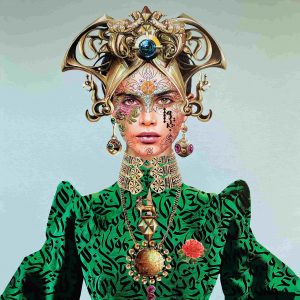
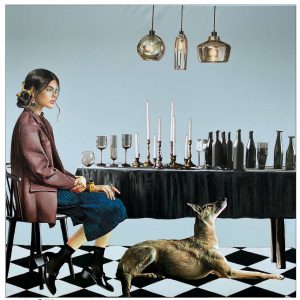
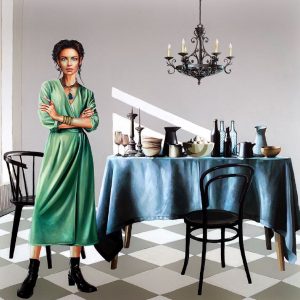
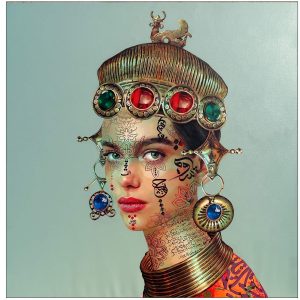
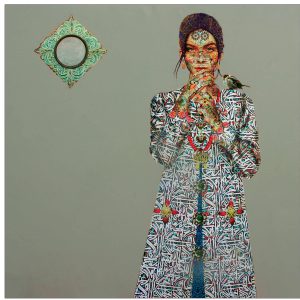
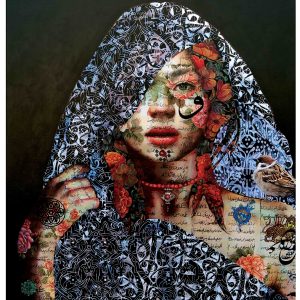
Born in Iran, Tohidloo studied painting at Tehran’s Fine Art University. After living in silence for a long time, she is determined to show the images that exist in her soul, images of the female spirit, without aesthetic trickeries. These images represent her: the way she feels, her spirit with its simple greatness, and images of silence, loneliness and distance. Tohidloo often decorates her paintings with quotations, which are mostly taken from ghazals (Persian odes) written by the renowned Jalāl ad-Dīn Muhammad Balkhi Rūmī, commonly known as Rumi.
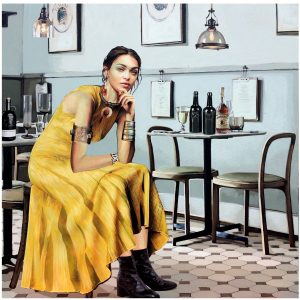
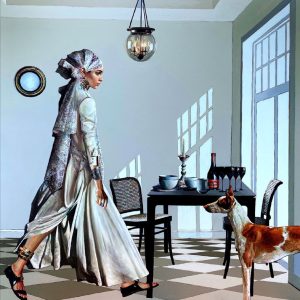
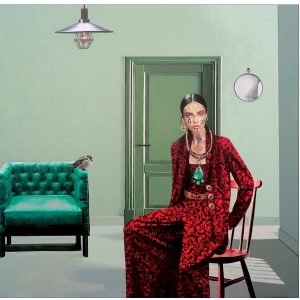
Today’s modern era, with all its progression, still has no answer for the loneliness of human beings. One reason for this is the humanity’s warped perception of one another and the conflicts between them. It seems like the same mystery that attempts to conceal the tragedy. Tohidloo’s women, who were abundant in the affliction of happiness in the past, are now looking for themselves within a cold frame of abandonment, which is inevitable due to loneliness, constantly in search of the time that has passed. In the end it is she, who is left alone, silent and lonely, who is worried about what has happened and what will happen.
These women, whose eyes are frigid and hollow with emptiness, still have hope. For them, hope is the only condition with which they are not afflicted, and only have loyalty as their greatest support. Long shadows behind their gazes represent the hidden powers of silent and lonely women.
Sardari, Tehran, 2020
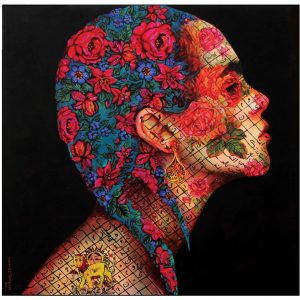
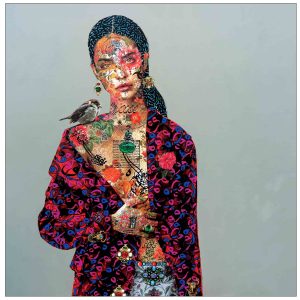
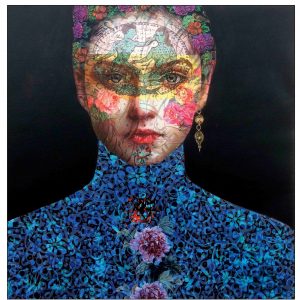
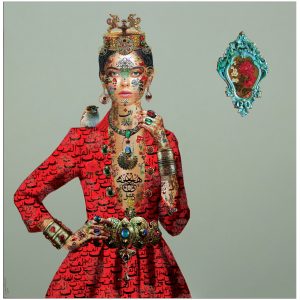
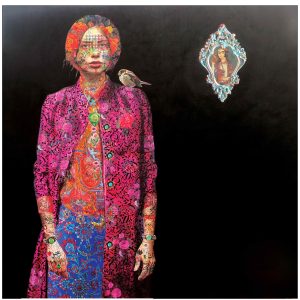
The new artworks that Solmaz has presented in these recent years attempt to talk openly to the viewer. In this series of works, the form has altered; without it being forced to keep a distance from the meaning. The blackness of the words and letters do not contain any evident or literal sense; the word is all about the meaning, a concept for speaking. The women of these works are similar to those contemporary ones we meet every day and are lost in the hues and cries of the surroundings. The excitement of the colour tries to replace this tumult. In these works, contrary to the previous ones, the connection with the work is considered to be way beyond identification; it is the viewer that is illustrated in the middle of the frame on the canvas. In some of these works, the bird has been placed in the hands of the narrator of the image with such serenity as if it is not worried about staying at all. The word is this: they will fly together.
Selected Events
Group Exhibitions:
- 2020 Affordable Art in Battersea, Eclectic Gallery, London, England.
- 2019 1912 Gallery, Washington D.C., United States.
- 2019 Affordable Art in Hampstead, England.
- 2018 Manchester Art Fair in Manchester, England.
- 2018 SAATCHI Gallery (Start Fair) in London, England.
- 2018 Affordable Art in Hampstead, England.
- 2014 Seyhoun Art Gallery, Iran.
- 2014 Gallery Novi Hram, Bosnia and Herzegovina, Sarajevo.
- 2009 2nd Festival of Contemporary Drawing of Iran, Tehran, Iran.
- 2008 International MARZIART Gallery, Hamburg, Germany.
- 2007 Open Art-Paris (Rencontre International d’Artistes), France.
- 2007 Christie’s Auctions in Jumeirah Emirates Towers Hotel, Dubai, United Arab Emirates.
- 2007 3th Visual Art Experimental Festival (Group Exhibition in Youth Art), Tehran, Iran.
- 2007 Fourth International Painting Biennial of the Islamic World, Tehran, Iran.
- 2007 The 6 Biennial of Persian Painting, Museum of Contemporary Arts, Tehran, Iran.
- 2006 Group Painting Exhibition in Moomayez Art Gallery (Khane Honarmandan), Tehran, Iran.
- 2005 “Nature in the Mind and Imagination the Iranian – Contemporary painters,” Tehran, Iran.
- 2004 Second Visual Art Experimental Festival (Group Exhibition in Youth Art), Tehran, Iran.
- 2004 Group Painting Exhibition in Iranian Student Festival, Beirut, Lebanon.
- 2000 Museum of Contemporary Arts – (Contemporary Drawing), Tehran, Iran.
Solo Exhibitions:
- 2020 “The Last Supper,” Seyhoun Art Gallery, Tehran, Iran.
- 2017 Seyhoun Art Gallery, Tehran, Iran.
- 2016 Seyhoun Art Gallery, Tehran, Iran.
- 2014 Impress Gallery, Dubai, United Arab Emirates.
- 2012 Seyhoun Art Gallery, Tehran, Iran.
- 2009 Seyhoun Art Gallery, Tehran, Iran.
- 2008 Seyhoun Art Gallery, Tehran, Iran.
- 2007 Seyhoun Art Gallery, Tehran, Iran.
- 2006 Seyhoun Art Gallery, Tehran, Iran.
- 2006 Day Art Gallery, Tehran, Iran.
- 2006 Laleh Art Gallery, Tehran, Iran.
- 2005 Seyhoun Art Gallery, Tehran, Iran.
- 2002 Embassy of the Czech Republic, Tehran, Iran.
More Artworks By Solmaz Tohidloo